Pruning for Clearance, Safety, and Shape

Tree Trimming in Indio & the Coachella Valley

Tree Trimming in Indio and across the Coachella Valley. Professional tree and palm service with careful planning, cleanup, and free estimates.

  • Licensed & Insured
  • Serving the Coachella Valley
  • Free Estimates

Practical Tree Trimming Across the Coachella Valley

Tree trimming helps manage dead or broken limbs, clearance problems, crowded growth, and canopies that have become difficult to live around. The right pruning plan starts with the specific objective, whether that is roof clearance, deadwood removal, street clearance, or correcting poorly placed growth. Species, tree condition, season, and the surrounding property all affect how much should actually be removed.

The goal is not to cut a tree as hard as possible. Good trimming starts with the reason for pruning and removes what is necessary to improve clearance, structure, or appearance without taking more live canopy than the tree can reasonably tolerate. In the Coachella Valley, that restraint is especially useful on shade trees where removing too much foliage can expose interior limbs and nearby surfaces to harsher sun.

Reasons Homeowners Request Tree Trimming

Dead and Broken Limb Removal

Deadwood can drop into yards, streets, driveways, roofs, and pool areas. Removing clearly dead or damaged branches is one of the most direct reasons to schedule pruning, especially before windy conditions expose weak material. Selective removal can reduce nuisance debris and overhead hazards while preserving the healthy portions of the canopy.

Roof and Structure Clearance

Branches rubbing tile, touching walls, crowding solar panels, or hanging over walkways can create recurring maintenance problems. Targeted pruning can restore practical clearance while keeping the tree. The objective is usable separation from the structure without unnecessarily stripping one side of the tree or creating a badly unbalanced canopy.

Driveway, Sidewalk, and Street Clearance

Low limbs can interfere with vehicles, visibility, pedestrians, gates, or service access. The amount of clearance needed depends on where the tree is located and what moves beneath it. That is especially important where private trees, street frontage, parked vehicles, and pedestrian routes compete for limited space.

Canopy Management

Some trees become dense or uneven as they grow. Selective pruning can remove crossing, damaged, poorly placed, or excessively crowded branches. Wholesale interior stripping or severe topping is not the same thing as thoughtful canopy management.

Trimming Is Different from Topping

Cutting a tree back to random stubs can create weak regrowth, large wounds, poor structure, and an unnatural appearance. A tree that is simply too large for its location may need a longer-term pruning plan or, in some cases, replacement rather than repeated hard topping. Selective reduction at appropriate branch unions generally leaves a more stable and natural result than simply shortening every limb to the same outline.

Coachella Valley communities have many heat-adapted trees that respond differently to pruning. Species, age, vigor, season, and the amount of foliage being removed should all influence the work. If you do not know the species, photos are fine when you request an estimate.

Palm Tree Trimming work in the Coachella Valley

Coachella Valley Tree Care

Built for Desert Properties

Palms, mature shade trees, tile roofs, pools, walls, narrow side yards, heat, and seasonal wind all change how tree work is planned across the valley.

See All Service Areas →

Tree Trimming Around Desert Landscaping

Many Coachella Valley properties have compact planting beds surrounded by rock, artificial turf, irrigation, walls, lighting, and hardscape. Dropping large limbs into those areas can damage more than the tree. Before trimming starts, the work zone and lowering needs should be considered.

Wind exposure is another local concern. Pruning can remove obvious deadwood and improve clearance, but aggressive thinning is not automatically better in windy areas. Removing too much interior growth can change how a canopy responds to wind. The specific tree should drive the decision.

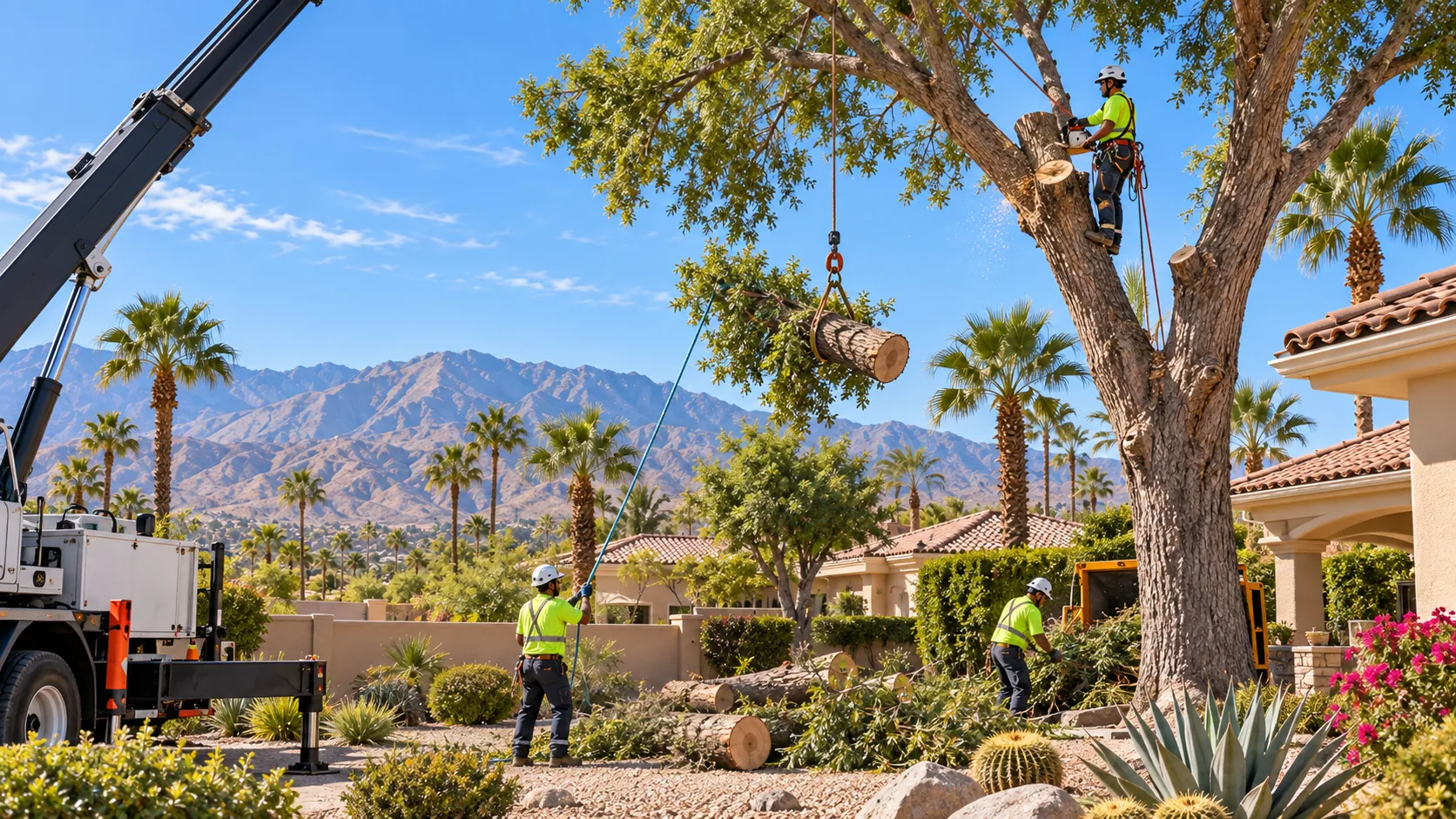
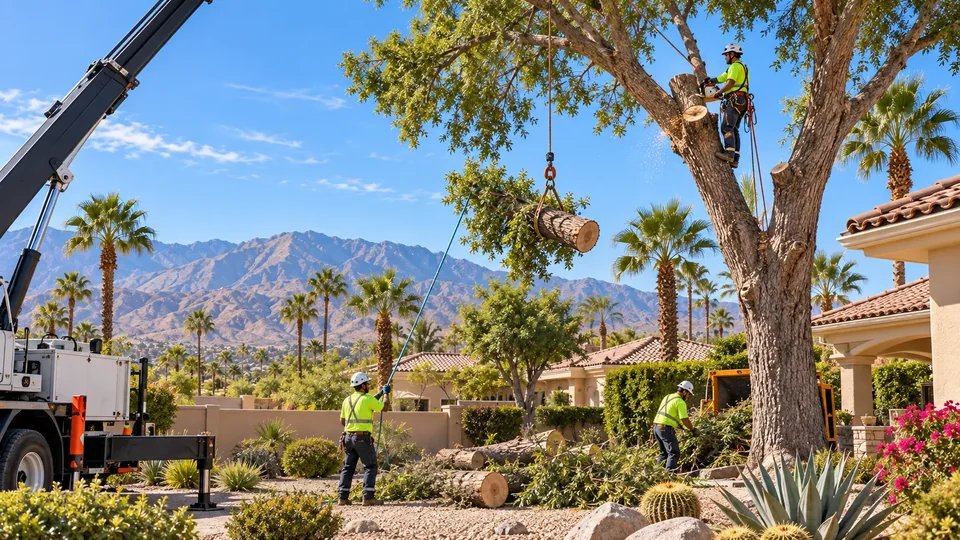
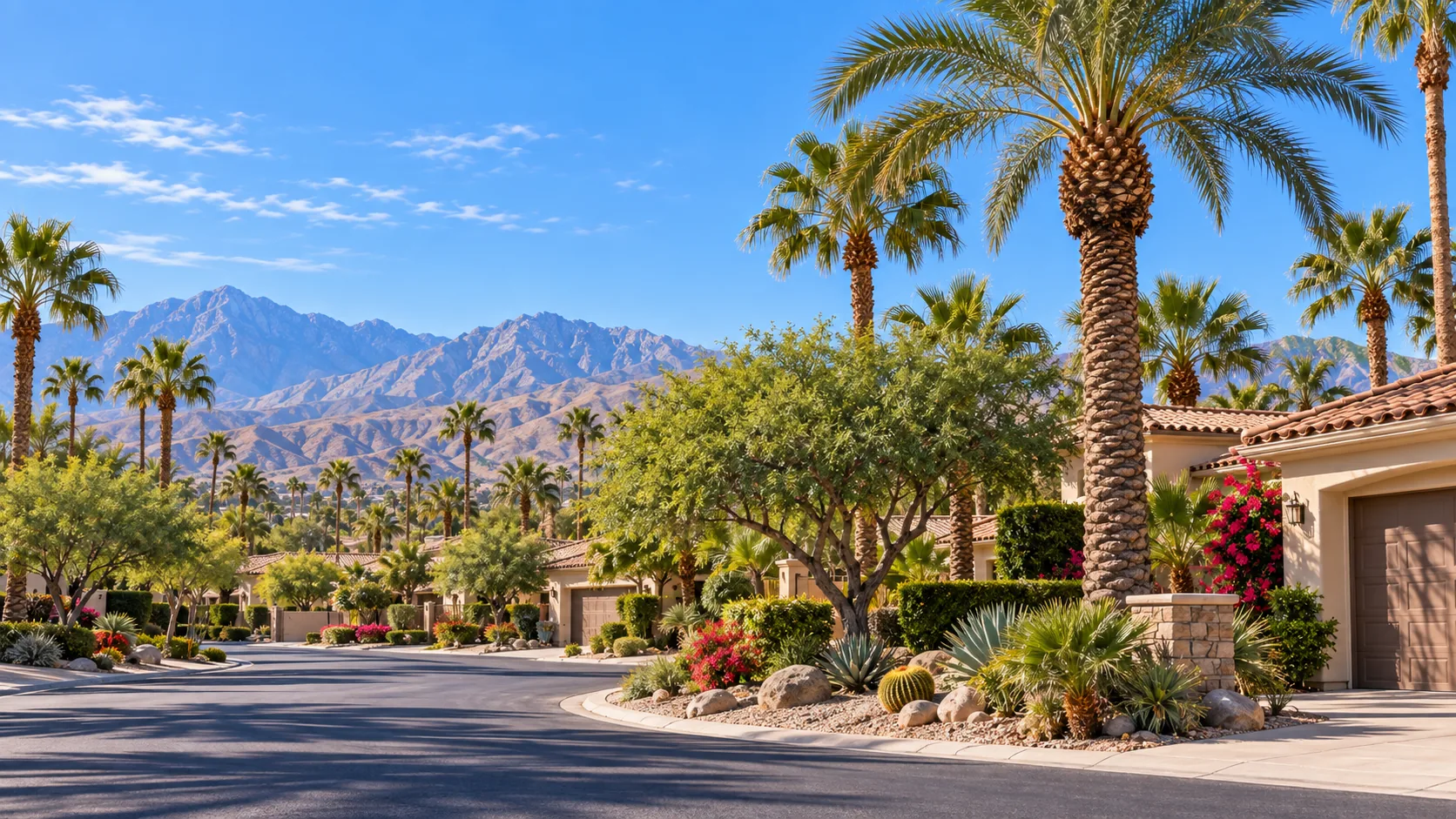
Coachella Valley homes with mature trees, palms, and desert landscaping

Coachella Valley Trimming Numbers and Conditions

A valley-wide trimming plan has to account for both jurisdiction and exposure. Indio's development standards provide one concrete example: limbs over public sidewalks are to be kept at least 8 feet above the sidewalk, and limbs over streets at least 13 feet above street level. Those are Indio public-clearance standards, not a blanket rule for every private tree in every valley city, but they show why a useful pruning scope should be measurable. "Trim it back" is vague. "Restore vehicle clearance," "keep limbs off the tile roof," or "raise the branch over the sidewalk" gives the crew a real objective.

The climate matters throughout the valley. Western Regional Climate Center period-of-record data for Indio shows an average July high of 106.9°F and roughly 182 days per year at 90°F or hotter. That east-valley heat is one reason not to strip a healthy canopy unnecessarily. On the west side, Palm Springs, Cathedral City, and Desert Hot Springs are more directly exposed to winds funneled through the San Gorgonio Pass. A 2026 National Weather Service advisory for the Coachella Valley called for 25-35 mph west winds and gusts up to 50 mph, with isolated 65 mph gusts through passes. Thoughtful pruning removes obvious hazards and improves clearance without assuming that aggressive thinning is automatically safer in wind.

The property pattern changes as you move through the valley. Palm Springs and Cathedral City include older neighborhoods and mature landscapes. Rancho Mirage, Palm Desert, Indian Wells, and La Quinta have extensive resort, golf, HOA, and pool-oriented landscaping where debris control and appearance matter. Indio and Coachella add dense master-planned communities and east-valley heat, while Thermal and Mecca bring more date-palm and agricultural context. The same pruning prescription should not be copied onto every tree in every part of the valley.
What Tree Trimming Can Include

Depending on the tree and the objective, a trimming job may include several different types of cuts and cleanup. The scope should be tied to the actual problem rather than a vague instruction to 'trim everything back.' That makes it easier to protect healthy canopy while still solving clearance, deadwood, or structural concerns. A clearance job over a roof may call for a different set of cuts than deadwood removal after wind damage or a visibility problem along a driveway.

  • dead or broken branch removal
  • clearance from roofs, walls, driveways, and walkways
  • selective reduction of overextended limbs
  • removal of crossing or damaged branches
  • canopy shaping where appropriate
  • removal of low growth that interferes with access
  • cleanup and hauling of cut material

Palm pruning is handled separately because palms grow differently and should not be treated like branching shade trees. See palm tree trimming. Fan palms and date palms have a single growing point and a different crown structure, so pruning decisions that are routine on branching trees do not transfer directly to palms.

What Affects Trimming Cost?

Price depends on the amount and difficulty of work rather than the word "trim." A small ornamental tree with easy access is different from a mature canopy over a roof or pool. Important factors include tree size, number of cuts, climbing or equipment needs, access, proximity to structures, debris volume, and whether multiple trees are handled in the same visit. Labor, climbing or lift access, rigging, debris volume, and the amount of cleanup can all move the estimate even when the trees are similar in height.

If you have several trees, send a rough count and photos of the whole property. That gives a better picture than one close-up image. A useful estimate should reflect the actual work area, access, debris handling, and finish condition rather than a generic price attached to the service name.

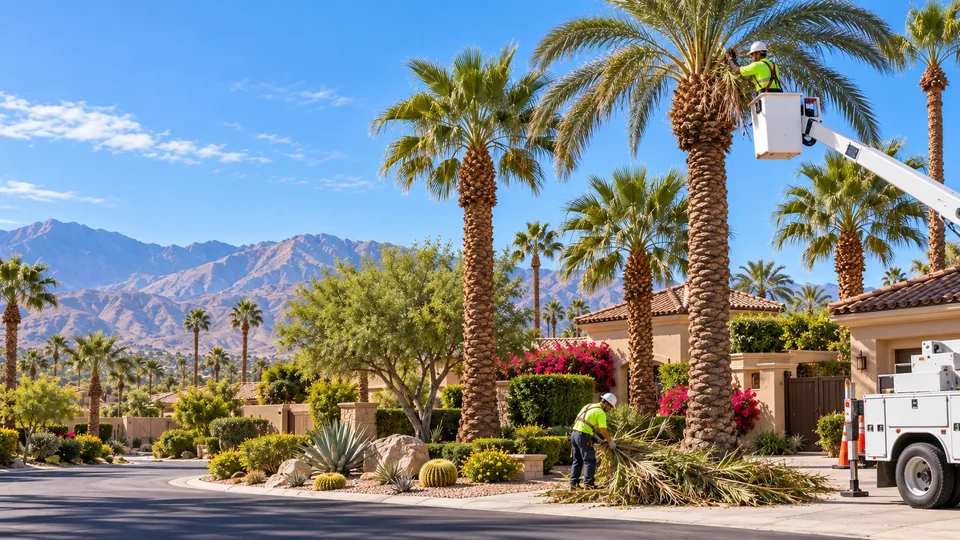
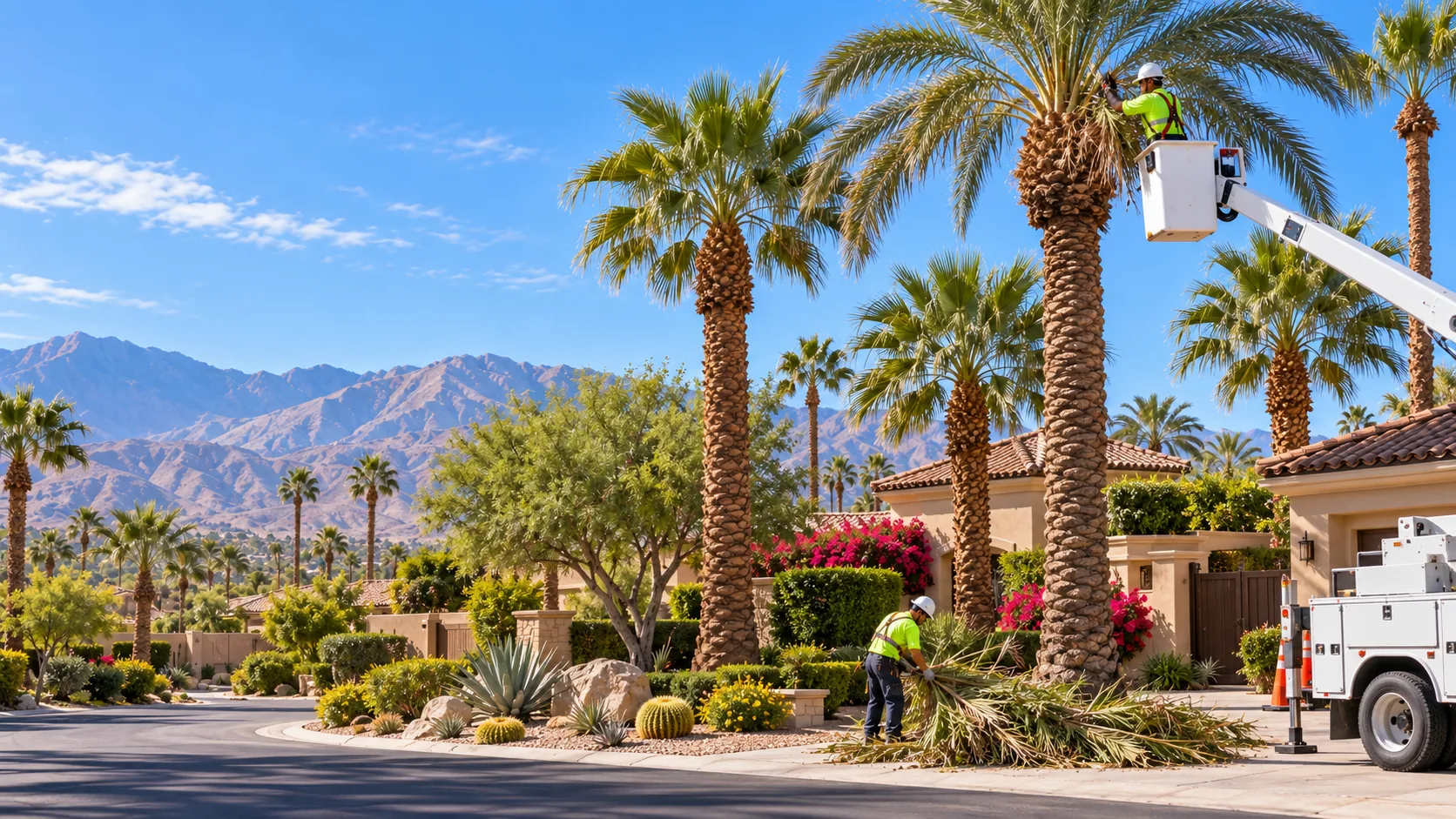
Palm trimming crew maintaining tall palms at a desert residence

A Simple Trimming Process

Start with the Objective

Tell us what is bothering you: dead branches, roof contact, low clearance, too much growth over the pool, or general maintenance. Clear objectives help avoid unnecessary cutting. A clear objective makes it much easier to avoid unnecessary cuts and to judge whether the finished canopy actually solved the original problem.

Look at the Tree and Surroundings

The job plan should account for species, condition, branch structure, buildings, landscape features, access, and where cut material can safely go. The surrounding property often determines where material can be lowered, staged, chipped, or carried out. On tight resort-style or HOA properties, protecting pools, tile roofs, walls, lighting, irrigation, and neighboring landscaping can be just as important as making the pruning cuts themselves.

Perform Targeted Pruning

Cuts should address the agreed scope. If the condition of the tree reveals a larger structural problem, that should be discussed before the work changes substantially. Cuts should support the stated objective while retaining as much useful, healthy canopy as the situation allows.

Clean up the Work Area

Clarify whether debris will be chipped, hauled, stacked, or left for green-waste handling. Cleanup expectations are part of the job, not an afterthought. Cleanup expectations should include branches, twigs, and chips in the agreed work zone so the property is left in a usable condition.

When Removal May Make More Sense

Trimming cannot fix every problem. A dead tree, severe structural failure, extensive decline, or a tree that has completely outgrown its location may be a tree removal candidate. The useful question is whether pruning can solve the actual problem without leaving a tree that still conflicts with the property.

Tree Trimming Service Areas

We provide tree trimming across the Coachella Valley, from Palm Springs, Cathedral City, and Desert Hot Springs through Rancho Mirage, Palm Desert, Indian Wells, La Quinta, Bermuda Dunes, and Thousand Palms, then east to Indio, Coachella, Thermal, and Mecca. See all service areas. The exact scope still depends on the individual property, because access and surrounding structures can change dramatically from one valley neighborhood to the next.

Tree Trimming FAQ

How Often Should Trees Be Trimmed?

There is no universal schedule. Species, age, growth rate, location, previous pruning, and the objective all matter. Inspect trees periodically and prune when there is a clear structural, clearance, deadwood, or maintenance reason.

Should Every Interior Branch Be Removed?

No. Excessive interior thinning can leave a tree with poor structure and too little live canopy. Selective pruning is generally more useful than stripping the center of the tree.

Can You Trim Trees over a Pool or Roof?

Those are common requests, but they require more planning for lowering branches and protecting the property. Include photos showing the tree and the surface below it. Those conditions simply require more controlled handling and a plan for protecting the surfaces and openings below the canopy.

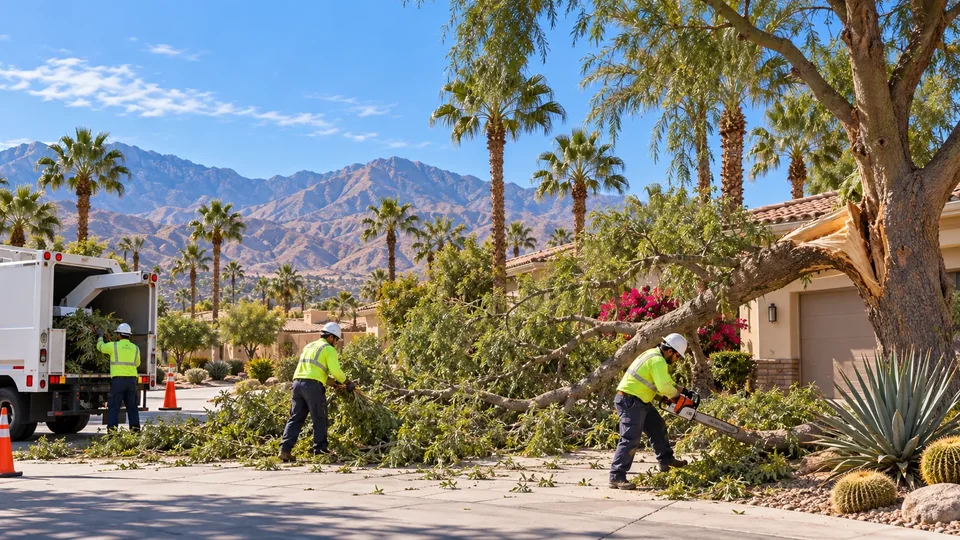
Professional tree crew performing controlled tree work near a residence

Request Tree Trimming Anywhere in the Coachella Valley

Send the address, photos if available, and a sentence explaining what you want changed. We will use that information to move the request toward an appropriate estimate. Photos that show the full tree or palm, the surrounding property, and the access route can make the first estimate conversation much more useful.

Tree Trimming Across the Coachella Valley

From Palm Springs to Coachella, the same service may require a different access, cleanup, or equipment plan depending on the property.

View all service areas →

Need Tree or Palm Work in the Coachella Valley?

Tell us what you need and where the property is located.

Call NowFree Estimate